
Table of Contents
History is full of dramatic, tension-filled moments that seem almost too bizarre to be true. But sometimes, it’s these very moments that define a turning point in geopolitics and international relations. One such moment occurred in the Demilitarized Zone (DMZ) of Korea in 1976—a seemingly simple incident involving an axe turned into a full-blown military standoff between the United States and North Korea.
The year was 1976, and the world was still entrenched in the Cold War, with tensions running high on the Korean Peninsula. The DMZ, a heavily guarded strip of land dividing North and South Korea, had always been a hotspot for conflict, but no one could have predicted the series of events that would unfold in August of that year. What began as a routine mission quickly spiraled into a life-or-death situation that could have ignited a larger military conflict. This was the infamous axe murder incident, and it nearly brought the U.S. and North Korea to the brink of war.
So, what led to such a dramatic standoff over an axe? What exactly happened during the incident, and what were the consequences? Let’s dive into the history of “An Axe Murder Triggers a Standoff in Korea’s DMZ, 1976,” exploring its significance and what it tells us about military tension, power, and diplomacy.
The Korean DMZ in 1976
To fully appreciate the gravity of the axe murder incident in 1976, it’s important to first understand the Korean Demilitarized Zone and its significance. The DMZ is a 2.5-mile wide strip of land that stretches across the Korean Peninsula, separating the communist regime of North Korea from the democratic South. Created as part of the Korean Armistice Agreement in 1953, the DMZ was intended to serve as a buffer zone between the two sides after the Korean War ended in a stalemate.
However, despite its “demilitarized” label, the area has always been one of the most heavily militarized regions in the world. Both North and South Korea maintain large military forces stationed along the DMZ, and tensions often run high in this volatile environment. Over the years, the DMZ became a flashpoint for border skirmishes, espionage, and military standoffs. Patrols, surveillance, and routine operations were a constant part of life for those stationed near the zone.
It was within this backdrop that the axe murder incident unfolded in 1976. The routine nature of military life at the DMZ would soon be shattered by an event that would have global consequences.
The Incident: The Killing of Two U.S. Soldiers
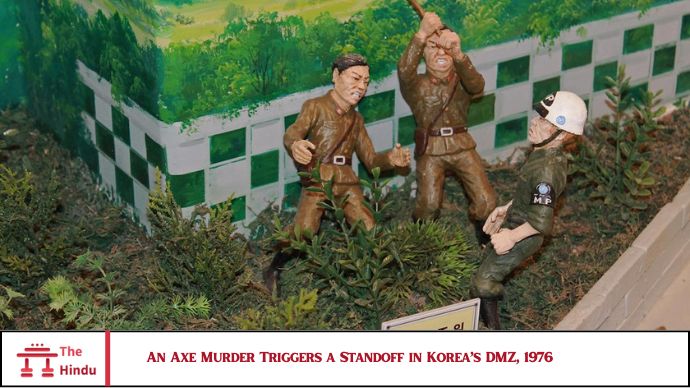
The story of the axe murder incident begins on August 18, 1976. A team of U.S. soldiers and South Korean troops was carrying out a relatively simple task—cutting down a tree that obstructed their line of sight in the Joint Security Area (JSA) of the DMZ. The tree was blocking the view of the North Korean side, which was a significant concern for security reasons.
At this point, tensions were already running high between the U.S. and North Korean forces stationed along the border. The JSA was a place where both sides often came into direct contact, and there was a constant, low-level threat of violence. What began as a relatively low-stakes task soon escalated in a shocking and violent way. Two U.S. soldiers, Lieutenant Mark Barrett and Private First Class Keith C. L., were tasked with cutting down the tree. As they went about their work, they were attacked by a group of North Korean soldiers, who approached them wielding axes.
In the brutal confrontation that followed, both U.S. soldiers were killed by the North Koreans. The violence was shocking not just because of the brutality of the act but also because it was carried out in broad daylight, with North Korean soldiers committing the murders in front of a group of witnesses. The deaths of these two soldiers were not only tragic—they were also a direct challenge to the U.S. military presence in the region.
The Response: Operation Paul Bunyan
The murder of the U.S. soldiers did not go unanswered. The U.S. military was not going to let this blatant act of aggression slide without a response, especially in such a sensitive area. But rather than escalating into full-scale combat, the U.S. chose a more calculated, strategic response—Operation Paul Bunyan.
The operation was designed to retaliate for the murders of the soldiers while avoiding a larger military conflict. Despite its seemingly light-hearted name (which referenced the famous giant lumberjack from American folklore), Operation Paul Bunyan was a show of military force that involved hundreds of soldiers, tanks, and armored vehicles.
The goal of the operation was clear: cut down the tree that had been the site of the soldiers’ deaths, as a symbolic act of defiance. But the operation was far more than just the removal of a tree—it was a message to North Korea that any further aggression would not be tolerated. The U.S. military and South Korean forces moved into the DMZ with a huge show of force, including helicopters, armored vehicles, and soldiers positioned in strategic locations to ensure that the operation could be carried out without interference.
Despite the show of strength, the operation was carried out without further violence. The tree was felled, and the U.S. forces withdrew from the area. The tree was gone, but the message had been delivered: the U.S. military would not be intimidated by North Korean aggression.
The Aftermath: The Diplomatic Consequences
The axe murder incident and the subsequent Operation Paul Bunyan had significant diplomatic and military consequences. For the U.S. government, the operation was an important display of strength and resolve. It showed that the U.S. would not allow its personnel to be murdered with impunity, particularly in a region as sensitive as the DMZ.
In North Korea, the operation was seen as a humiliating defeat. The North Korean leadership had hoped that the attack on the U.S. soldiers would go unpunished, but the operation proved otherwise. North Korea was forced to consider the potential consequences of future acts of aggression against the U.S. and its allies.
On the global stage, the incident served as a reminder of the fragile nature of peace in the Korean Peninsula. Even a seemingly insignificant incident—such as a tree being cut down—could spiral out of control and lead to dangerous military confrontations. The event also highlighted the complexity of the Cold War era, where proxy wars and tensions often played out in hot spots like the DMZ.
May you also like it:
Are Refurbished Phones Safe to Buy? Understanding the Risks
Elon Musk Says the Real Threat to Democracy is People Who Accuse Trump of Endangering It
Operation Paul Bunyan: The US Military’s Showdown Over a Tree
FAQs
1. What was the cause of the 1976 axe murder incident?
The incident occurred when two U.S. soldiers were killed by North Korean forces while attempting to cut down a tree that obstructed the line of sight in the DMZ.
2. What was the response to the murder of the U.S. soldiers?
The U.S. military launched Operation Paul Bunyan, a show of force to remove the tree and send a message to North Korea that aggression would not be tolerated.
3. Why was the tree significant?
The tree blocked the line of sight between U.S. and South Korean forces in the Joint Security Area of the DMZ, making it a key strategic target.
4. How did the U.S. military respond during Operation Paul Bunyan?
The U.S. deployed a large number of soldiers, armored vehicles, and helicopters to ensure the operation was carried out without interference from North Korean forces.
5. What were the diplomatic consequences of the incident?
The axe murder and subsequent Operation Paul Bunyan increased tensions between North and South Korea and underscored the volatility of the Korean Peninsula during the Cold War.
6. Did the axe murder incident lead to further violence?
Despite the brutal attack, the U.S. military’s response was measured, and the operation was carried out without further violence, although it did send a strong message to North Korea.
Conclusion
The axe murder incident of 1976 is a stark reminder of the high-stakes nature of military operations during the Cold War era. What began as a seemingly small event—a simple task of cutting down a tree—escalated into a military standoff with global consequences. The U.S. military’s response, Operation Paul Bunyan, is a testament to the careful balancing act that diplomats and military leaders must perform when tensions are high and a single misstep could lead to disastrous consequences.
Though the axe murder incident may seem like an odd and almost absurd chapter in military history, it was a moment that highlighted the importance of power, diplomacy, and the fragile nature of peace in the world. The lessons from this event remain relevant today as we continue to navigate complex international relations and maintain peace in volatile regions.
